
Corporate Governance and Business Ethics
Importance
Effective corporate governance and strong business ethics are critical challenges for every organization. Upholding high standards of ethical conduct and good governance not only enhances transparency and reduces the risk of fraud, but also builds trust and satisfaction among all stakeholders, including internal stakeholders such as, shareholders whose rights and benefits are protected, and employees who are treated fairly, provided with a safe working environment, fair compensation, and opportunities for stable career growth. For external stakeholders, such as business partners, fair treatment is ensuring; customers gain confidence in the quality, safety, and standardization of goods and services. At the same time, communities, and the government benefit from responsible environmental and social practices. These outcomes foster trust, add value to the organization, and generate business revenue. Moreover, a strong internal control system is essential in preventing misconduct, minimizing legal disputes, and safeguarding the organization’s reputation, all of which directly impact growth opportunities and sustainable profitability.
Central Retail is committed to conducting business with transparency and responsibility toward its stakeholders, based on effective corporate governance and ethical business practices. Central Retail has established policies overseen by the Board of Directors and the Corporate Governance and Sustainability Committee, alongside implementing prevention measures, and providing employee training to address associated risks. Through this commitment, Central Retail has earned the trust of its stakeholders, leading to increased brand loyalty, improved access to capital, and the ability to attract and retain top talent. These factors are key drivers to support the organization's stable and sustainable growth.
Management Approach
Transparency and accountability are essential foundations for an effective corporate governance in today's competitive and ethically conscious market. To ensure that the operations are transparent and accountable, Central Retail appointed the Board of Directors based on their ethics, diverse expertise, and experience in the retail industry.
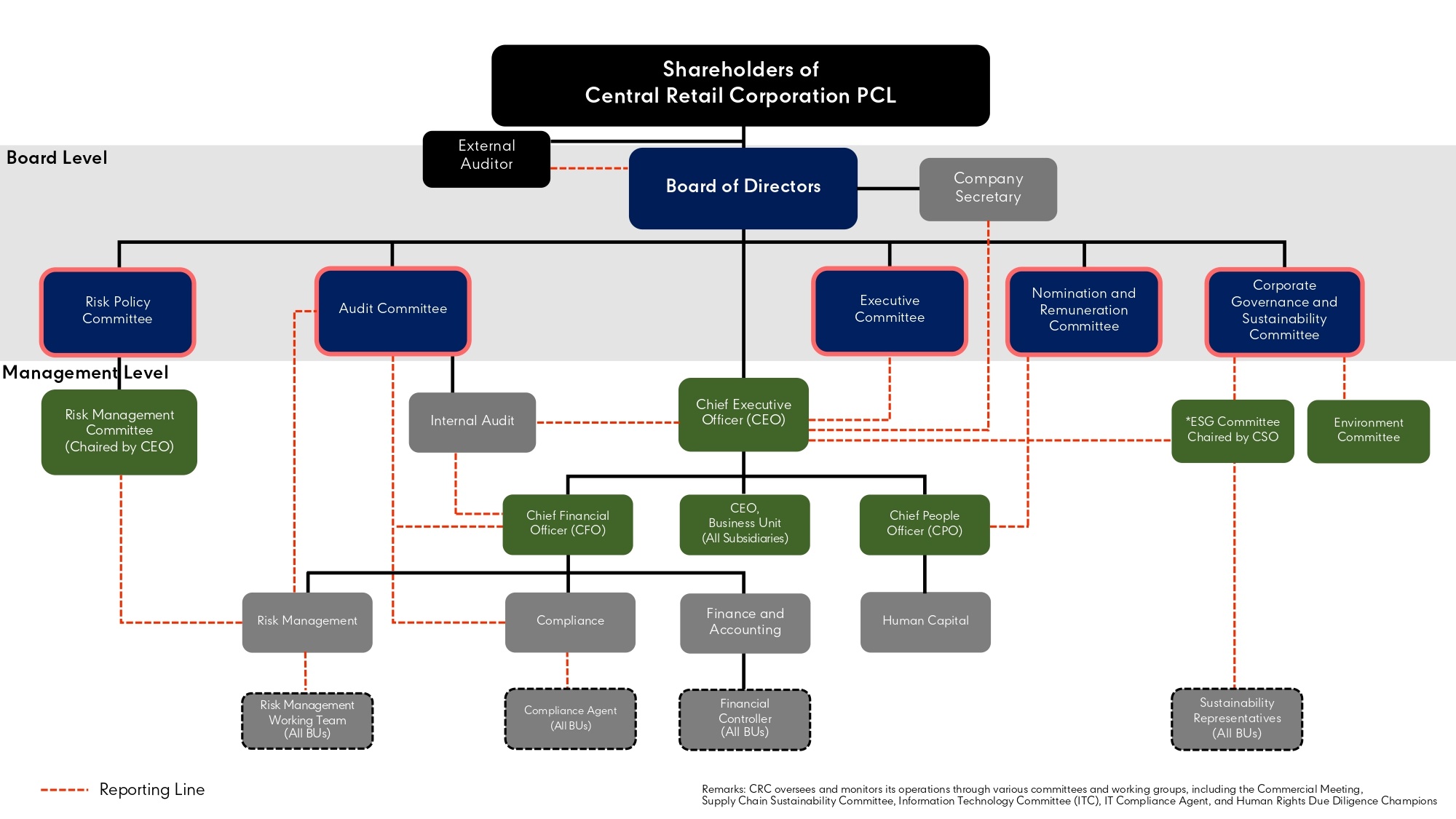
Furthermore, Central Retail has established the Corporate Governance and Sustainability Committee to oversee the implementation and effectiveness of corporate governance and business ethics practices, as well as to ensure their effective integration across all business operations. The Committee also provides guidance to drive continuous improvement in Central Retail’s ethical and sustainable business practices. In addition, Central Retail has established a management-level ESG Committee, chaired by the Chief Sustainability Officer (CSO), to oversee corporate sustainability and ESG matters and support the Corporate Governance and Sustainability Committee in driving sustainability strategies and action plans. These efforts cover governance, social, and environmental dimensions, with the objective of creating long-term value for Central Retail.
Central Retail has adopted a comprehensive set of policies to guide ethical conduct across all areas of its operations. Central Retail’s corporate governance and anti-corruption policies provide clear guidelines and a solid foundation for responsible decision-making by employees and stakeholders. To further strengthen its commitment to transparency and accountability, Central Retail has a whistleblowing policy which allows any stakeholder to report potential misconduct or unethical behavior while protecting whistleblowers from any form of retaliation, ensuring their confidence, and encouraging them to voice concerns. This confidential system fosters a culture of open communication and empowering all stakeholders to contribute to a more ethical business.
Composition of the Board of Directors

Executive Director

Non-Executive Director

Independent Director

Female Director
Central Retail has established a Board structure, composition, and set of qualifications that are appropriate and well-aligned with the nature of its business operations. The Board consists of directors with diverse skills, knowledge, expertise, and experience, including diversity in gender and age, to strengthen well-rounded strategic perspectives and enhance effective corporate governance in driving Central Retail's business.
As of 31 December 2025, the Board comprises 17 directors, consisting of 15 non-executive directors and 2 executive directors, and 6 independent directors. These independent directors meet independence qualifications set by Central Retail that are more stringent than those required under the regulations of the Capital Market Supervisory Board.
Currently, 12 directors are Independent Directors according to the criteria of S&P Global CSA, and 6 directors are Independent Directors according to SEC requirements & Central Retail’s Definition of Independent Director Qualification, as follows:
| Director’s Name | Type of Director | Independent Directors under Central Retail and SEC Definition | Independent Directors under S&P Global CSA Definition | |
|---|---|---|---|---|
| 6 persons | 12 persons | |||
| 1. | Dr. Prasarn Trairatvorakul Chairman | Non-executive Director | - | |
| 2. | Mr. Sudhitham Chirathivat | Non-executive Director | - | |
| 3. | Dr. Pakorn Peetathawatchai | Non-executive Director | ||
| 4. | Mrs. Pratana Mongkolkul | Non-executive Director | ||
| 5. | Mr. Sompong Tantapart | Non-executive Director | ||
| 6. | Mr. Kanchit Bunajinda | Non-executive Director | ||
| 7. | Dr. Kobsak Pootrakool | Non-executive Director | ||
| 8. | Ms. Parnsiree Amatayakul | Non-executive Director | ||
| 9. | Mr. Roongrote Rangsiyopash | Non-executive Director | - | |
| 10. | Prof. Emeritus Dr. Suthiphand Chirathivat | Non-executive Director | - | |
| 11. | Mrs. Yuwadee Chirathivat | Non-executive Director | - | - |
| 12. | Mr. Prin Chirathivat | Non-executive Director | - | |
| 13. | Mr. Tos Chirathivat | Non-executive Director | - | - |
| 14. | Mr. Pichai Chirathivat | Non-executive Director | - | |
| 15. | Ms. Sukulaya Uahwatanasakul | Executive Director | - | - |
| 16. | Mr. Suthisarn Chirathivat Chief Executive Officer | Executive Director | - | - |
Qualification of Independent Director
Independent directors should possess the qualifications of independence as set by CRC and subject to the guideline in the announcement of Thai Capital Market Supervisory Board and the principles set by SEC and SET. CRC has set the criteria which are stricter than the requirement of the Capital Market Supervisory Board as follows:
- Not holding more than 0.5% of the total outstanding voting shares of CRC, its parent company, subsidiary or associated company, major shareholders or controlling person including shares held by related persons of the independent director.
- Neither being nor having been an executive director, officer, employee, advisor who receives a salary of CRC or controlling person of CRC, its parent company, subsidiary, associated company, a same-level subsidiary, major shareholder or controlling person, unless the foregoing status ended not less than 2 years prior to the date of appointment. Such disqualified characteristics exclude the case that the independent director has been a government officer or consultant of government agency which is a major shareholder or controlling person of CRC.
- Not being a person related by blood or registration under law, such as a father, mother, spouse, sibling, or child, including spouses of children of directors, executives, major shareholders, controlling persons, or persons to be nominated as directors, executives or controlling persons of CRC or its subsidiaries.
-
Not having nor having had a business relationship with CRC, its parent company, subsidiary, associated company, major shareholder or controlling person, in a manner which may interfere with his or her independent judgment, and neither being nor having been a substantial shareholder or controlling person of any entity having business relationship with CRC, its parent company, subsidiary, associated company, major shareholder or controlling person; unless the foregoing status ended not less than 2 years prior to the date of appointment.
The term ‘business relationship’ under the above paragraph includes any normal business transaction, rental, or lease of immovable properties, transaction relating to assets or services, or grant or receipt of financial support through receiving or extending loans, guarantee, providing assets as collateral, including any other similar action of which value more than 3% of the net tangible assets or exceeds THB 20 million, whichever is lower. The value of each transaction is based on the calculation method for the values of related party transactions under the Announcement of the Thai Capital Market Supervisory Board regarding the related party transactions. Under the regulation, all transactions occurring within 1 year of preceding transactions must be included in such calculation.
- Neither being nor having been an auditor of CRC, its parent company, subsidiary, associated company, major shareholder or controlling person nor being a substantial shareholder, controlling person or supplier of an audit firm which employs auditors of CRC, its parent company, subsidiary, associated company, major shareholder or controlling person; unless the foregoing relationship ended not less than 2 years from the date of appointment.
- Neither being nor having been any kind of professional advisor including a legal advisor or financial advisor who receives an annual service fee exceeding THB 2 million from CRC, its parent company, subsidiary, associated company, major shareholder or controlling person, and neither being nor having been a substantial shareholder, controlling person or supplier of the professional advisor; unless the foregoing relationship ended not less than 2 years from the date of appointment.
- Not being a director who has been appointed as representative of CRC’s directors, major shareholders, or shareholders who are related to the major shareholders.
- Not conducting any businesses which have the same nature as or are in competition with CRC’s or its subsidiaries or neither being a significant partner in a partnership, executive director, employee, officer or consultant who receives regular salary, shareholder holding more than 1% of the voting shares of businesses which have the same nature as or in competition with CRC or its subsidiaries.
- Not having any characteristics that could prevent him/her from giving independent opinions concerning CRC’s operation.
In this regard, independent directors should be able to ensure equal benefits for all shareholders to avoid conflict of interests. Additionally, they shall participate in the Board of Directors’ Meeting to give their opinions freely.
An independent director is a non-executive member and does not have a pecuniary relationship with the Company. He or she must be independent from the major shareholders or a group of major shareholders and Company’s executives.
- Holding no more than 1% of the total voting shares of the company, parent company, subsidiary, associate company, major shareholder or controlling person of the company, including shares held by the connected persons of such independent director;
- Not being or having been an executive director, employee, staff, advisor earning regular monthly salary or the controlling person of the company, its parent company, subsidiary, associate company, same-level subsidiary, major shareholder or controlling person, unless the foregoing status has ended for at least two years. In this regard, such prohibited characteristics shall exclude the case where an independent director used to be a government official or advisor of a governmental agency, which is a major shareholder or the controlling person of the company;
- Not being a person who is related by blood or legal registration as father, mother, spouse, sibling and child, including spouse of child, other directors, executives, major shareholders, controlling person or person to be nominated as director, executive or controlling person of the company or its subsidiary;
-
Not having or having had a business relationship with the company, its parent company, subsidiary, associate company, major shareholder or controlling person in a manner that may interfere with independent discretion, which includes not being or having been a significant shareholder or the controlling person of any person having a business relationship with the company, its parent company, subsidiary, associate company, major shareholder or controlling person, unless such foregoing relationships have ended for at least two years.
The business relationship under the above paragraph shall include normal business transactions, rental or lease of real estate, transactions related to assets or services or granting or receipt of financial assistance through receiving or extending loan, guarantee, providing assets as collateral, and any other similar actions, which result in the company or the counterparty being subject to indebtedness payable to the other party in an amount staring from 3% of the net tangible assets of the company or from twenty million baht or more, whichever amount is lower. In this regard, the calculation of such indebtedness shall be in accordance with the method for calculating the value of related party transactions under the Notification of the Capital Market Supervisory Board Re: Rules on Execution of Related Party Transactions, mutatis mutandis. In any case, the consideration of such indebtedness shall include the indebtedness incurred during the period of one year to the date of establishing the business relationship with the related person;
- Not being or having been an auditor of the company, its parent company, subsidiary, associate company, majority shareholder, or controlling person, and not being a significant shareholder, controlling person, or partner of the audit firm which employs the auditor of the company, its parent company, subsidiary, associate company, majority shareholder, or controlling person, unless the foregoing relationship has ended for not less than two years.;
- Not being or having been a provider of professional services, which includes serving as a legal advisor or financial advisor being paid with a service fee of more than two million baht per year by the company, its parent company, subsidiary, associated company, majority shareholder, or controlling person, and not being a significant shareholder, controlling person, or partner of such provider of professional services, unless the foregoing relationship has ended for not less than two year.;
- Not being a director who is appointed as the representative of directors of the company, major shareholder, or shareholder who is a connected person of a majority shareholder;
- Not undertaking any business of the same nature and in significant competition with the business of the company or its subsidiary, or not being a significant partner in a partnership, or an executive director, employee, staff, advisor earning regular monthly salary, or holding more than 1% of the voting shares of another company that undertakes a business of the same nature and in significant competition with the business of the company or its subsidiary;
- Not having any other characteristics that cause the inability to express independent opinions on the business operation of the company.
After being appointed as an independent director, the independent director may be assigned by the Board of Directors to make a decision on the business operation of the company, its parent company, subsidiary, associate company, same-level subsidiary, major shareholder or controlling person in the form of collective decision.
Independent directors are non-executive directors that are independent by meeting at least 4 of the 9 criteria (of which at least 2 of the 3 first criteria) listed below:
- The director must not have been employed by the Company in an executive capacity within the last year.
- The director must not accept or have a “Family Member who accepts any payments from the Company or any parent or subsidiary of the Company in excess of $60,000 during the current fiscal year” other than those permitted by SEC Rule 4200 Definitions, including i) payments arising solely from investments in the Company's securities; or ii) payments under non-discretionary charitable contribution matching programs. Payments that do not meet these two criteria are disallowed.
- The director must not be a “Family Member of an individual who is […] was employed by the Company or by any parent or subsidiary of the Company as an executive officer
- The director (must not be and must not be affiliated with a company that is) an advisor or consultant to the Company or a member of the Company’s senior management
- The director must not be affiliated with a significant customer or supplier of the Company.
- The director must have no personal services contract(s) with the Company or a member of the Company’s senior management
- The director must not be affiliated with a not-for-profit entity that receives significant contributions from the Company.
- The director must not have been a partner or employee of the Company’s outside auditor during the past year.
- The director must not have any other conflict of interest that the board itself determines to mean they cannot be considered independent.
Central Retail clearly separates the roles and responsibilities of the Board of Directors and Management to ensure an appropriate balance of authority and effective corporate governance. The Board of Directors is led by the Chairman, while Management is led by the Chief Executive Officer (CEO). The positions of Chairman and CEO are held by different individuals. The Chairman is a Non-Executive Director and is not involved in the day-to-day management of Central Retail. The Chairman provides leadership to the Board and oversees Central Retail's strategic direction and corporate governance, while the CEO is responsible for the day-to-day management of Central Retail and for implementing the strategy approved by the Board of Directors.
The Board of Directors recognizes the importance of corporate governance and of performing its duties in compliance with applicable laws, objectives, regulations, and resolutions, with responsibility, due care, and integrity to safeguard the rights of, and act in the best interests of, Central Retail and all its shareholders. However, even when such actions are taken within the appropriate legal framework and with the intent to benefit Central Retail, they may nonetheless impact stakeholders’ interests and expose the directors to personal liability. Accordingly, the directors of Central Retail and its subsidiaries acknowledge that there is no limitation on their liabilities; provided that such actions are lawful, Central Retail and its subsidiaries will extend full protection and support in the conduct of those actions.
Corporate Governance and Code of Conduct Handbook
To ensure that Central Retail’s directors, executives, employees, and all relevant persons conduct their duties with responsibility, integrity, transparency, accountability, and ethics toward all stakeholders, Central Retail has developed a Corporate Governance and Code of Conduct Handbook. This handbook contains policies and guidelines on topics such as Business Ethics, whistleblowing channels, compliance process, and all policies and guidelines for good corporate governance. The Board of Directors, through the Corporate Governance and Sustainability Committee, is responsible for periodically review of the handbook to ensure its relevance and alignment with current circumstances.
The handbook is available for download on Central Retail’s website and has been communicated to all directors, executives, and employees through the intranet, email, and training programs. Furthermore, all personnel are required to acknowledge, adhere to, and strictly comply with the handbook's provisions.
Corporate Governance and Code of Conduct Handbook
Response to Employee Misconducts
The employees who were non-compliant to Code of Conduct will be investigated and subjected to punishment according to Central Retail workplace regulation, which may include termination of employment and consideration of legal action. In addition, the support to others person’s misconduct, the omission or negligence when witnessing the non-compliance or the act that impedes the investigation process, and an unfair act to the person giving truth are deemed as the non-compliance.
The employees who were involved in the cases of corruption, bribery, and fraud were accordingly disciplined by termination of employment; notifying the concerned employee of the investigation procedure and result as well as remedial measure; the concerned employee made responsible for the remedial cost. Central Retail will consider taking a legal action to prevent any future wrongdoings.
In the event of any wrongdoing involving customers, Central Retail will contact the customers to apologize, provide an explanation, and compensate for any damages incurred.
To prevent cases of corruption, bribery and fraud, Central Retail has put in place prevention measures, updated its internal control process, and added training on business ethics.
Central Retail regularly reviews its policies, procedures, and Corporate Governance and Code of Conduct Handbook annually. The annual review process ensures that the handbook remains relevant and aligned with evolving industry standards and best practices. All employees will be informed of the revision via email and intranet.
Project Highlights
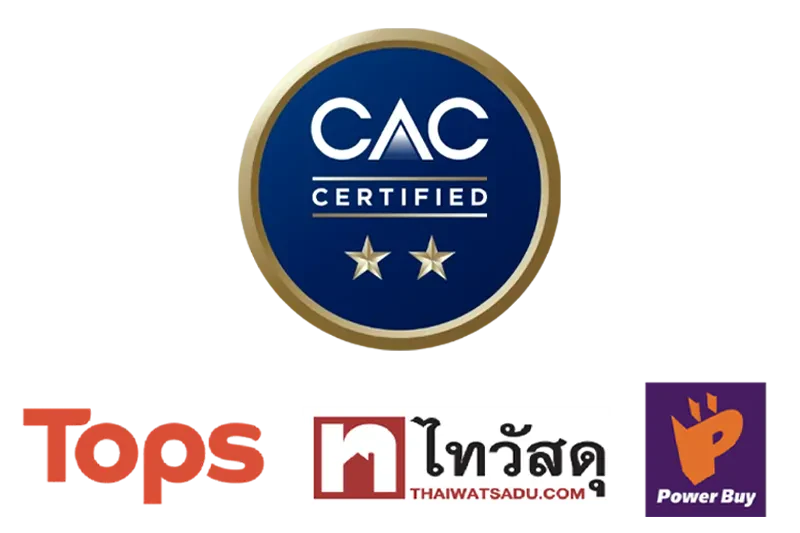
Central Retail’s affiliates have been certified as members of the Thai Private Sector Collective Action Against Corruption (CAC)
Central Food Retail Co., Ltd., CRC Thai Watsadu Co., Ltd., and Power Buy Co., Ltd., were certified on March 31, 2026, with the support of Central Retail Corporation Co., Ltd., which participated in the special program of CAC (CAC Change Agent). Central Retail joined CAC program to promote transparent and accountable business practices, and to foster an organizational culture grounded in ethics and integrity throughout the entire business value chain.
Code of Conduct Communication and Training
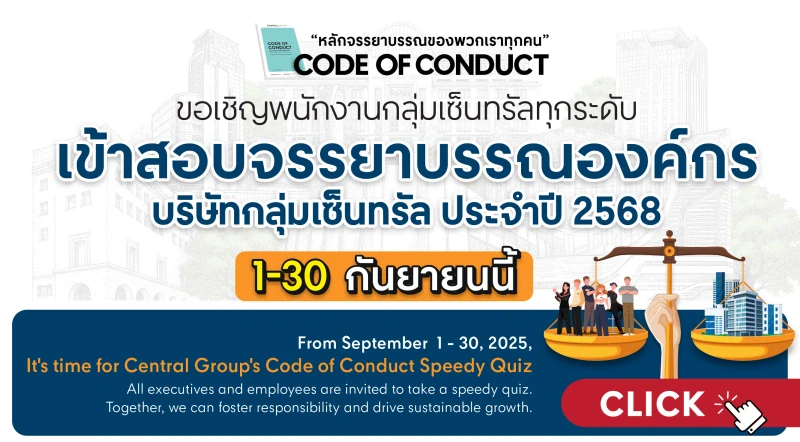
Central Retail has communicated its Good Corporate Governance principles and Code of Conduct to directors, executives, and employees to foster ethical business understanding and define roles in upholding integrity standards. Communication is delivered through various channels, including meetings, emails, internal communications, videos, Corporate Governance Day activities, social media such as Line Groups, Microsoft Teams, and Viva Engage, and the corporate websites. Furthermore, Central Retail has developed Code of Conduct training courses and assessments covering key topics, such as work ethics, Insider Trading, Conflict of Interest, Anti-Corruption, Human Rights, the Personal Data Protection Act (PDPA), Information Security, non-harassment, and non-bullying. In 2025, 100% of the Board of Directors and 99% of employees in Thailand, comprising 97% of executives and 99% of general staff, acknowledged and attended the training, with 100% of participants passing the assessment.
Additionally, the training was provided to employees regarding Central Retail’s whistleblowing guidelines. This training explains the procedures employees must follow when filing a complaint, including the requirement to provide complete details and supporting evidence. Also clearly determine between actions that constitute a violation and those that do not, ensuring an accurate and precise understanding among employees. The training aims to raise awareness of Central Retail's official whistleblowing channels and provide guidance on how to access and utilize these channels effectively.

Our Stories
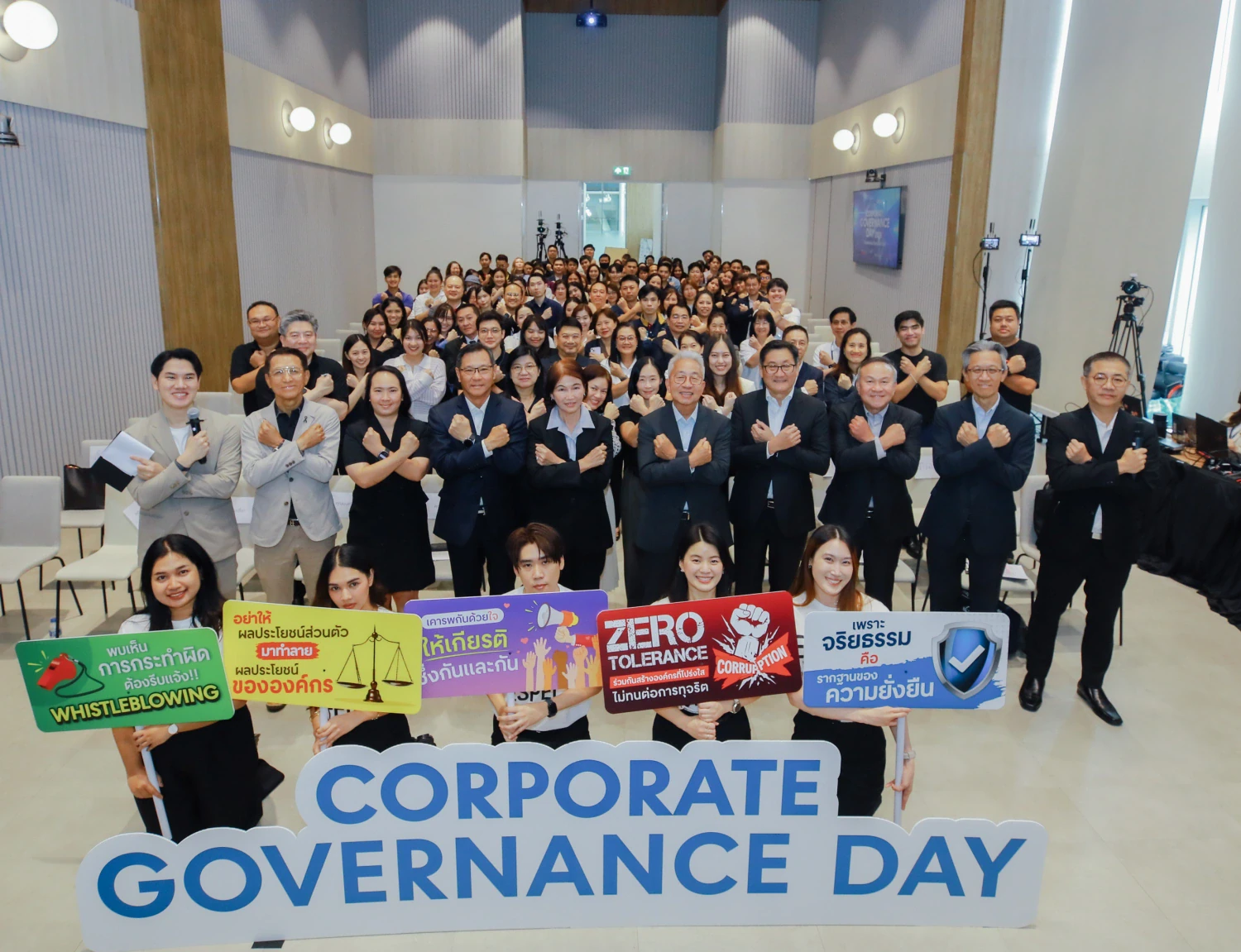
Central Group Corporate Governance Day 2026
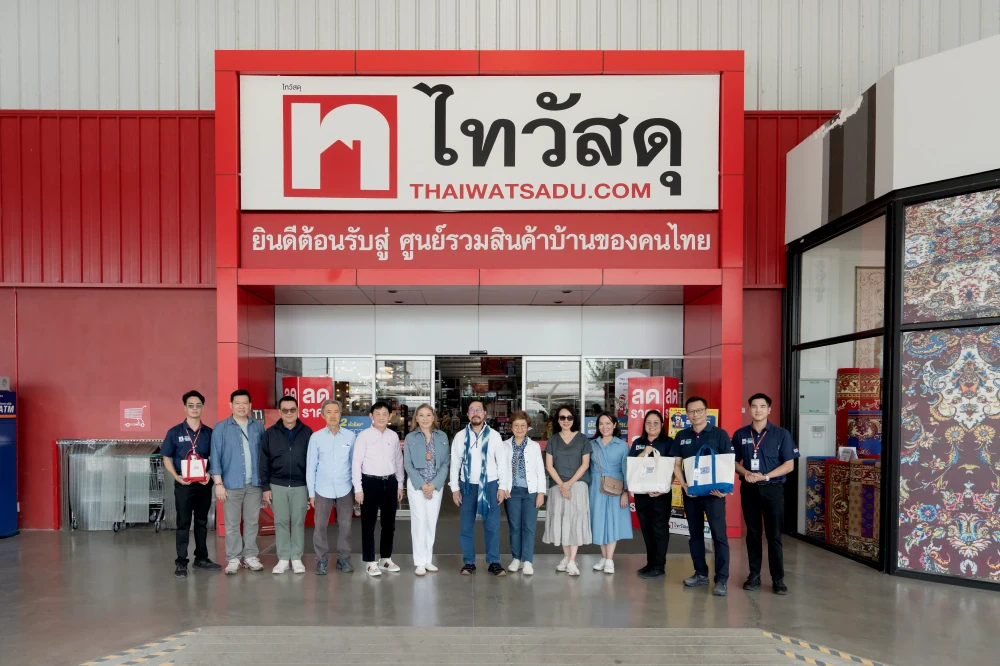
คณะกรรมการบริษัท และคณะกรรมการบรรษัทภิบาลและการพัฒนาเพื่อความยั่งยืน ลงพื้นที่จังหวัดเชียงใหม่ เยี่ยมชมธุรกิจในเครือ และโครงการด้านความยั่งยืน